


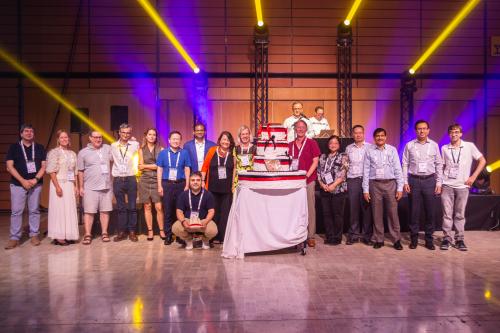
ICPR 2026: a remarkable edition organized in Lyon by the Imagine team
From the 17th to the 22nd of August 2026, the Imagine team at LIRIS led the local organization in Lyon of the 27th edition of the International Conference on Pattern Recognition (ICPR), the IAPR’s flagship event. With more than 1,150 participants from around the world, this edition represented a major scientific and organizational undertaking for the laboratory and for INSA Lyon. Véronique Eglin and Bertrand Kerautret, the Local Organization Chairs, coordinated the local organization. Stéphane Bres, Killian Barrere, Laure Tougne Rodet, and Mihaela Scuturici also served in leadership roles on the conference organizing committee. The organization also benefited from the particularly strong involvement of several LIRIS doctoral students, notably Kévin, Juliana, and François, as well as numerous other volunteers who helped out throughout the week.
The Cité Internationale de Lyon hosted the main conference from the 17th to the 20th of August, before the event continued on the 21st and 22nd of August at the INSA Lyon campus in La Doua for the satellite workshops. This two-site format made it possible to welcome the international pattern recognition community in a setting that was both scientific and local, drawing on the infrastructure and strengths of the Lyon location.
ICPR is the IAPR's flagship event and one of the leading conferences in the field of pattern recognition, covering a broad range of topics: computer vision, machine learning, image processing, speech and natural language processing, and sensor signal processing.
This 2026 edition brought together the international scientific community around a dense and varied program:
- 4 keynote talks given by internationally recognized researchers
- numerous parallel scientific sessions, focused notably on Pattern Recognition, Computer Vision, Machine Learning, medical imaging, biometrics, and document analysis
- poster sessions of 500 posters, allowing researchers and doctoral students to present their work and exchange with the community
- a Doctoral Consortium, dedicated to mentoring 35 young researchers by 11 senior researchers
- several thematic workshops, held notably on the Doua campus
- sessions dedicated to awards and scientific distinctions
- a gala dinner, which was also an opportunity to celebrate the IAPR's 50th anniversary and announce the upcoming ICPR editions
The four invited speakers illustrated the diversity of current research in pattern recognition and artificial intelligence:
- Henrik I. Christensen (Contextual Robotics Institute, UC San Diego) "Building a perception stack for autonomous driving"
- Alicia Fornés (Universitat Autònoma de Barcelona) "Challenges in Handwriting Recognition: The case of Historical Texts, Music Scores and Ciphers"
- Cuntai Guan (Nanyang Technological University) "Building a Foundation Model for EEG-based Brain-Computer Interfaces"
- Zhu Jun (Tsinghua University) "Towards Building General World Models"
ICPR 2026 also hosted the three 2026 IAPR Lecture Prize recipients, each of whom gave a plenary lecture associated with their distinction:
- Jiří Matas (Czech Technical University) received the IAPR King-Sun Fu Prize for his major contributions to evidence aggregation in geometric computer vision. His lecture, titled "Benchmarking for Robust Recognition in the Era of Multimodal Large Language Models", addressed the challenges of evaluating foundation models trained on massive datasets.
- Zhangyang "Atlas" Wang (University of Texas at Austin) was awarded the IAPR J. K. Aggarwal Prize for his contributions to the efficient training and deployment of generative models, with applications to language and vision. He presented his work in a lecture titled "Where Does Learning Live in the Spectrum? From Principal Low-Rank Gradients to Off-Principal RL Post-Training".
- Sanghamitra Bandopadhyay (Indian Statistical Institute, Kolkata) received the IAPR Maria Petrou Prize for her pioneering contributions to pattern recognition, evolutionary computation, and computational biology, as well as for her role as a role model for young researchers. Her lecture, "From Biological Data to Discovery: Computational Methods for Life Sciences", explored the contribution of computational methods to biological and medical research.
ICPR 2026 benefited from the support of 15 sponsors, across several categories:
- Silver Sponsor: IMDS
- Start-up Sponsors: Elevate, Exco, Yooz
- Academic Sponsors: INSA Lyon, Université Lyon 2, LIRIS, CNRS, ICOM Lyon 2
- Awards Sponsor: Springer Nature
- Other sponsors: Elsevier, Région Auvergne-Rhône-Alpes, Métropole de Lyon
More information, the detailed program, and the full list of sessions are available at: https://icpr2026.org/